
Short answer
If you are learning French in Canada, focus on the French you actually meet: government pages, school material, workplace messages, Quebec media, transit notices, signs, forms, and everyday web pages. Use AI selectively to understand the sentence, then study the grammar, vocabulary, pronunciation, and repeated patterns so the next Canadian French text becomes easier.
Best workflow for Canada: read real Canadian French, explain difficult sentences, learn the reusable vocabulary, listen to audio, and review the phrases you are likely to see again.
Best for: English speakers in Canada learning French for school, work, travel, Quebec life, federal jobs, or personal confidence.
Related guides: personalized AI French learning, read French articles with grammar and review, and French pronunciation audio.
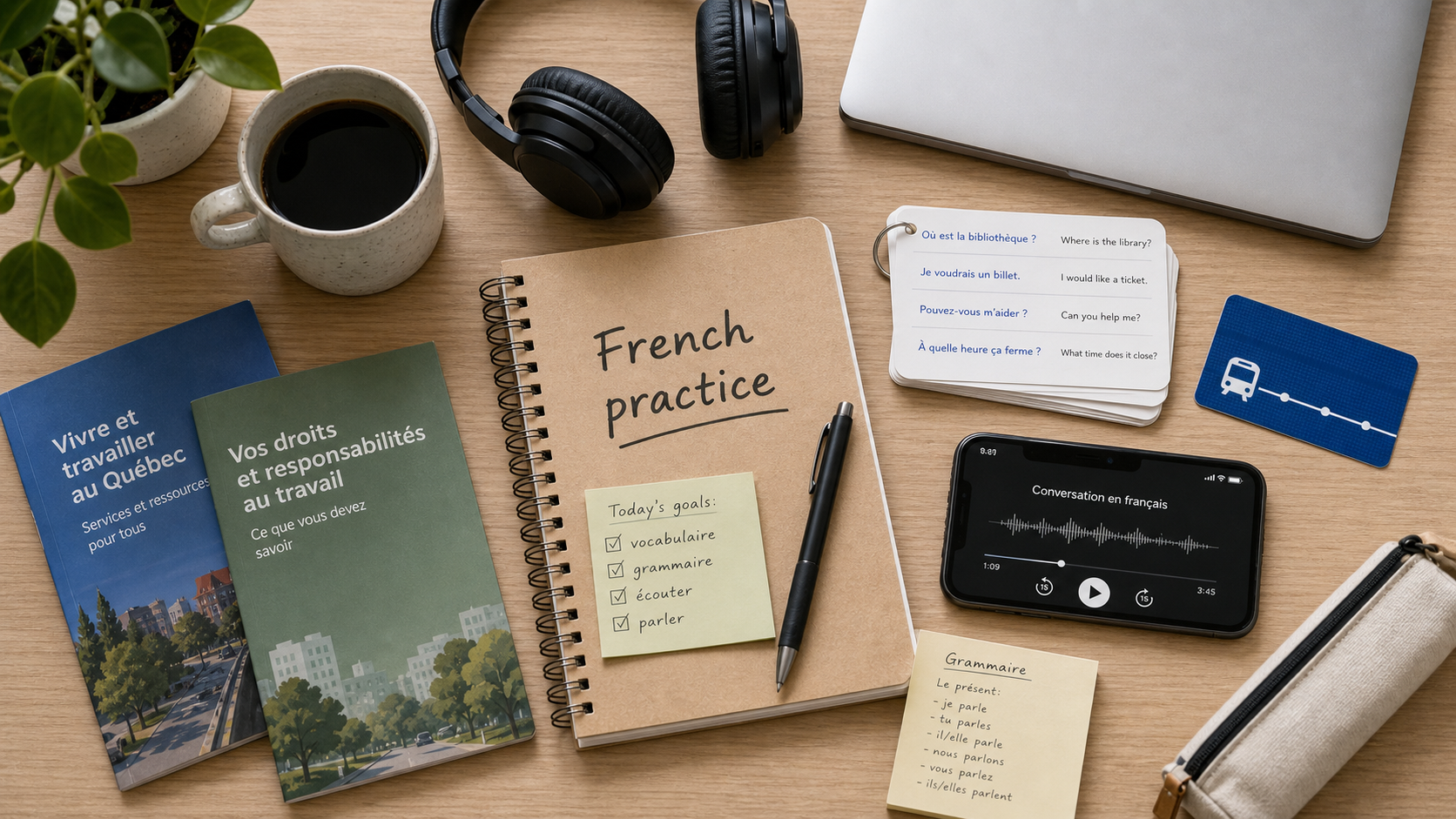
Why learning French in Canada is different
French in Canada is not just an academic subject. It shows up in public services, packaging, school requirements, job postings, airport signs, government forms, news headlines, and everyday life in Quebec and many bilingual communities.
That changes the learning goal. You do not only need textbook French. You need practical reading confidence: the ability to understand notices, emails, short articles, workplace instructions, and official language that may be formal or unfamiliar.
For many Canadian learners, the most useful question is not "How do I become fluent fast?" It is "How do I understand the French that is already around me?"
Start with Canadian French reading situations
Build your practice around texts you might actually need:
| Situation | Example text | What to practise |
|---|---|---|
| School | Assignment instructions, course pages | Academic verbs and formal directions |
| Work | Bilingual emails, job postings, HR pages | Polite phrases and workplace vocabulary |
| Travel | Transit notices, hotel messages, menus | Practical nouns, times, locations |
| Quebec life | Local news, apartment listings, city services | Everyday public vocabulary |
| Federal services | Forms, benefits pages, official notices | Formal structure and precise wording |
This keeps your study grounded. A learner in Canada benefits more from understanding Veuillez remplir ce formulaire than memorizing a random list of animal names.
Example: Canadian French you might see
Take this sentence:
Veuillez soumettre votre demande avant la date limite indiquée.
A translation gives you:
Please submit your application before the indicated deadline.
For a Canadian learner, the useful pieces are:
| French | Meaning | Why it matters |
|---|---|---|
| veuillez | please / kindly | Formal instruction, common in official writing |
| soumettre | to submit | Useful for school, work, immigration, and forms |
| votre demande | your request / application | Common in administrative French |
| date limite | deadline | Essential school and work vocabulary |
| indiquée | indicated / shown | Feminine agreement with date limite |
This one sentence teaches a whole pattern for official French. Once you know it, similar phrases become much easier: Veuillez fournir, Veuillez confirmer, Veuillez consulter, avant la date prévue.
Do not rely only on bilingual signs
Canada makes it easy to see English and French side by side. That can help, but it can also make you skip the French completely.
Use bilingual text actively:
- Read the French first.
- Guess the meaning.
- Check the English.
- Pick one French phrase worth remembering.
- Listen to or repeat the phrase if pronunciation matters.
This turns bilingual Canada into a practice environment instead of a shortcut around French.
Learn the words Canada keeps reusing
Canadian French learning becomes easier when you collect high-frequency public words and phrases.
| French | English | Where you will see it |
|---|---|---|
| renseignements | information | Forms, public services |
| demande | request / application | Government, school, work |
| permis | permit / licence | Driving, housing, services |
| assurance | insurance | Health, work, finance |
| emploi | job / employment | Job postings |
| logement | housing | Rentals, city pages |
| horaire | schedule | Transit, school, work |
| frais | fees / costs | School, services, accounts |
| obligatoire | mandatory | Rules and requirements |
| disponible | available | Services, listings |
Do not just memorize the English. Save each word inside a phrase:
- les renseignements personnels — personal information
- faire une demande — to apply / make a request
- un permis de conduire — a driver's licence
- les frais de scolarité — tuition fees
Phrases transfer better than isolated words.
Use AI learning like a tutor, not a crutch
A standard translator can tell you what a sentence means. A learner-focused AI system should also explain why the sentence works, remember what you studied, and help you review similar patterns later.
When you paste a Canadian French sentence into Apprendr, use the result in this order:
- Read the meaning support to confirm the sentence.
- Read the grammar explanation to identify the structure.
- Save two or three vocabulary items you expect to see again.
- Listen to the French audio.
- Let repeated phrases become future review material.
- Reread the original French sentence without looking at the English.
Those last steps matter. The goal is not to collect translations. The goal is to return to the French with more confidence and remember the patterns that keep reappearing.
Quebec French vs. classroom French
If you live in or read content from Quebec, you will meet expressions and phrasing that do not always match classroom examples. This is normal. The core grammar is the same, but vocabulary, informal speech, and cultural references can differ.
For reading practice, start with standard written French from Quebec news, public services, and school or workplace pages. Then add more informal content when you are ready.
Useful early categories:
- Public notices and city pages
- Weather and transit updates
- Short news explainers
- Apartment and job listings
- Restaurant and event pages
Save informal expressions when they appear, but do not let slang become the center of your study too early. Formal and semi-formal French will carry you through more Canadian situations.
A weekly Canada-focused study routine
Use this routine once a week:
| Time | Task |
|---|---|
| 5 minutes | Pick one Canadian French page: school, work, public service, local news, or travel |
| 5 minutes | Read the title and first section without translating |
| 7 minutes | Study three difficult sentences with grammar and vocabulary |
| 5 minutes | Save five useful Canadian French phrases |
| 3 minutes | Listen to the sentence audio and repeat the most useful phrase |
This 25-minute routine is practical because it uses French you are likely to meet again. It also builds confidence for real-world reading, not just app exercises.
What Apprendr helps with
Apprendr is useful for Canadian French learners because it combines the pieces that are usually scattered across separate tools:
- Meaning support for difficult French
- Grammar explanation in plain English
- Vocabulary extraction from real sentences
- CEFR-level adaptation from A1 to C2
- Native-quality audio for pronunciation practice
- Saved history and generated review material
- Web app and Chrome extension workflows
Use the Apprendr Chrome extension when reading Canadian French on the web. Select a sentence from a page, turn it into a learning session, study the explanation, then keep reading.
If you are comparing tools, start with Apprendr vs Google Translate and best free French translation tools.
The main rule for Canadian learners
Learn from the French that is already around you.
Canada gives English speakers more everyday exposure to French than they often realize. Use that exposure deliberately: signs, forms, websites, job posts, school pages, news, and public notices. Study selectively, review repeated patterns, listen to the sentence, and build a phrase bank from real Canadian contexts.