Short answer
The best way to make learning French stick is to turn the French you already meet in daily life into practice material. Instead of studying random lists, choose a topic you care about, work through one real sentence, save the useful vocabulary and grammar, listen to the audio, then review similar patterns repeatedly over time.
Best workflow: pick an interest, choose your level, study one real sentence, extract vocabulary and grammar, listen to it, then revisit related patterns in future sessions.
Best for: learners who want French practice to feel connected to their life, not like a disconnected textbook checklist.
Related guides: personalized AI French learning, learn French from articles, French vocabulary practice, and French grammar explainer.
Why learning French from daily life beats random practice
Most learners do not quit French because they lack resources. They quit because the resources feel disconnected from their real life.
A vocabulary app may teach you animals, office supplies, or airport phrases before those words matter to you. A grammar book may explain the subjunctive before you have seen it in a sentence you care about. A translator may give you an answer, but it usually does not turn that answer into something you can review and reuse.
Personalized French learning starts from a different question:
What French is already showing up in your life, interests, work, school, travel, media, or curiosity?
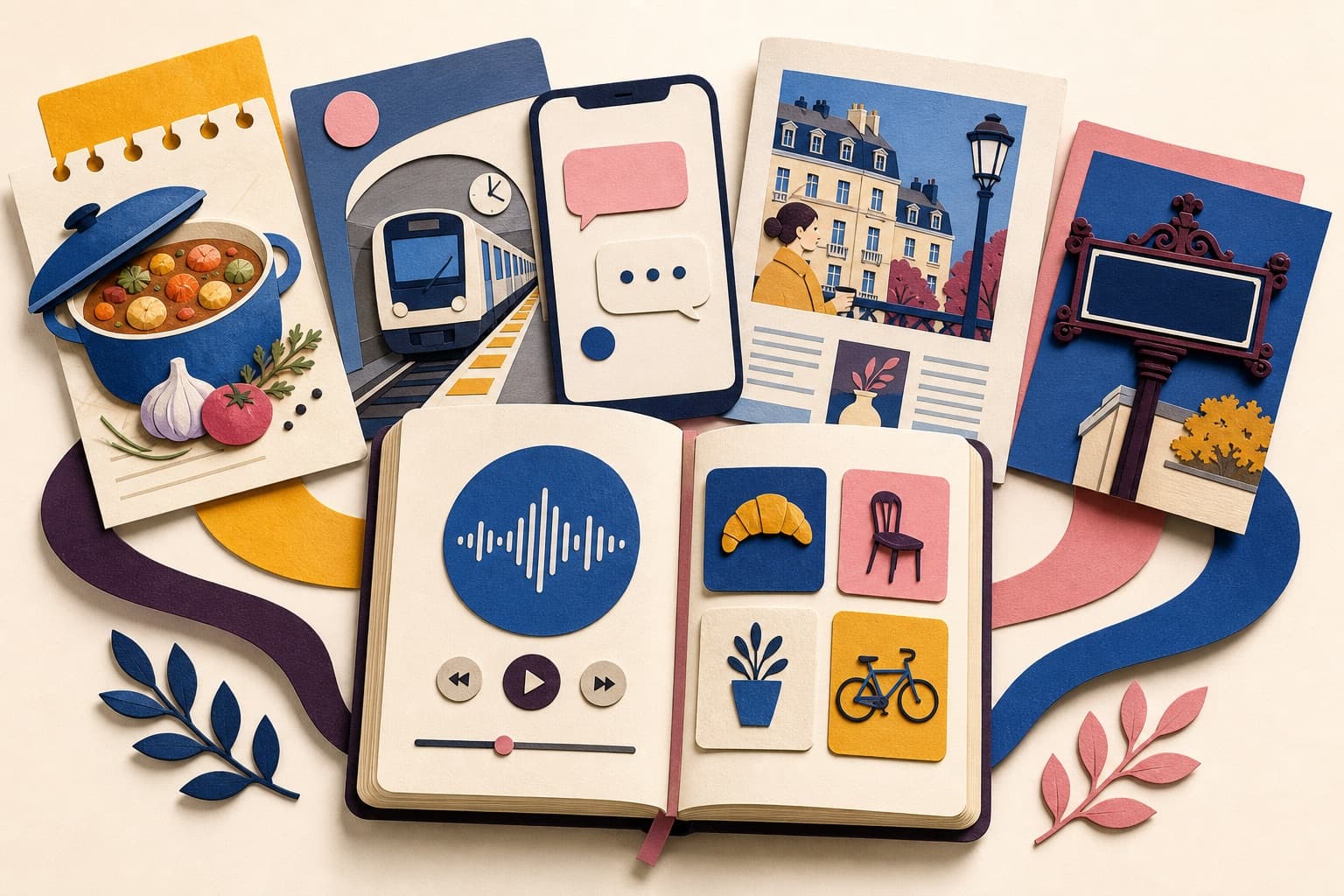
That question changes the whole study loop. A sentence from a recipe, news article, YouTube comment, school text, café menu, immigration guide, song lyric, or social post becomes the raw material for your next lesson.
The Apprendr loop
A personalized French learning journey has five parts:
- Pick the kind of French you actually care about.
- Set the level that matches you today.
- Turn one real sentence into translation, grammar, vocabulary, and audio.
- Save the useful pieces for review.
- Repeat with related material so patterns come back again.
The important word is repeat. One explanation can help you understand a sentence. Repeated exposure to similar vocabulary, grammar, and sentence patterns is what makes the knowledge durable.
Example: one interest becomes one lesson
Imagine you care about food and recipes. You find this sentence:
Ajoutez les tomates et laissez cuire pendant dix minutes.
A generic translation gives you:
Add the tomatoes and let cook for ten minutes.
A personalized lesson does more:
| Layer | What you learn |
|---|---|
| Meaning | This is a recipe instruction. |
| Grammar | Ajoutez and laissez are command forms. |
| Vocabulary | ajouter, tomates, laisser cuire, pendant dix minutes. |
| Audio | You hear the rhythm of the instruction. |
| Review | Similar recipe commands can appear again later. |
This sentence is small, but it is useful because it belongs to something you already care about. If you keep studying recipe language, the same patterns will return: coupez, mélangez, faites chauffer, laissez reposer, servez avec.
That is a personalized learning path forming from your own interests.
Choose daily material by interest
Your best French practice is not always the most prestigious French practice. It is the practice you will actually return to.
| Interest | Good daily material | What you build |
|---|---|---|
| News | Headlines, short local articles, explainers | Connectors, formal vocabulary, reported speech |
| Travel | Menus, signs, transit pages, hotel messages | Practical phrases and everyday questions |
| Work or school | Documents, assignments, emails, summaries | Academic and professional structure |
| Food | Recipes, café menus, cooking videos | Commands, quantities, sensory vocabulary |
| Culture | Songs, film summaries, book reviews | Opinion language and style |
| Social posts | Comments, captions, Reddit, YouTube | Informal French and spoken patterns |
The goal is not to cover everything. The goal is to build a path where each lesson connects to something you might see again.
Match explanations to your level
A personalized journey also means the explanation should match your level.
An A1 learner does not need a dense grammar lecture. A B2 learner may want nuance, register, and alternate phrasing. The same sentence can become a different learning material depending on where you are.
| Level | What the material should emphasize |
|---|---|
| A1 | Basic meaning, subject, verb, essential vocabulary |
| A2 | Common phrases, present and past patterns, simple rewrites |
| B1 | Sentence chunks, connectors, pronouns, reusable grammar |
| B2 | Nuance, register, idioms, more natural phrasing |
| C1+ | Style, implication, cultural context, subtle alternatives |
For example, a beginner studying Je voudrais un billet pour Paris mostly needs the useful phrase je voudrais. A more advanced learner might study politeness, register, and alternatives like j'aimerais réserver or serait-il possible de.
Repetition is where personalization pays off
Personalization is not only about the first explanation. It becomes powerful when your past learning shapes what you see next.
If you keep studying travel French, your review should bring back travel verbs, polite requests, time phrases, and common questions. If you keep studying French news, your review should surface connectors like cependant, selon, en revanche, and ainsi.
This is why a learning journey is different from a translation history. A translation history is a list of past answers. A learning journey turns past answers into future practice.
Useful review items include:
- Vocabulary you have seen more than once
- Grammar patterns that keep blocking you
- Phrases tied to your interests
- Sentences that are just above your current level
- Audio for phrases you can read but not yet recognize by ear
A simple weekly routine
Use this routine three times a week:
| Time | Task |
|---|---|
| 2 minutes | Pick one piece of French from your daily life or interests |
| 5 minutes | Turn one sentence into translation, grammar, vocabulary, and audio |
| 5 minutes | Save three to five useful phrases or patterns |
| 3 minutes | Listen and repeat the sentence aloud |
| 5 minutes | Review older phrases from the same interest area |
This routine is short enough to repeat. That matters more than doing one long study session and disappearing for two weeks.
Where Apprendr fits
Apprendr is built around this personalized loop. It helps you choose your level and interests, then turns real French into learning material: translation, grammar notes, vocabulary, audio, and review prompts.
You can start with the getting started flow, bring your own sentence to the dashboard, or use the Chrome extension when French appears while you browse.
The product goal is not to be another place to collect translations. The goal is to help learners build a highly personal, repeated French learning journey from the material they already care about.
The main rule
Do not ask, “What should every French learner study next?”
Ask, “What French did I encounter today, and how can I turn it into tomorrow's review?”
That shift is the difference between generic study and personalized learning. French becomes easier to continue when the material comes from your life, repeats over time, and grows with your level.