Short answer
The best way to build French vocabulary is to learn words from real sentences tied to your interests, then review them repeatedly in context. Instead of memorizing random lists forever, collect useful words from articles, recipes, messages, subtitles, travel pages, school texts, or any French you actually want to understand.
Best workflow: choose one interest, study one short French sentence, save three to five useful words with the full sentence, listen to the audio, then review words that keep appearing across similar material.
Best for: learners who know some common French words but want vocabulary that feels memorable, useful, and connected to real life.
Related guides: 100 common French words, learning French from daily life, reading French articles with translation, and personalized AI French learning.
Why random vocabulary lists stop working
A basic word list is useful at the beginning. You need words like être, avoir, aller, faire, jour, temps, and parce que because they appear everywhere.
But after the first few hundred words, generic lists become less helpful. They often teach words in isolation, without the sentence patterns that make them usable. You may recognize a word on a flashcard and still miss it in a real article, message, or video subtitle.
Vocabulary sticks better when each word has context:
- a topic you care about
- a sentence where the word does real work
- grammar around the word
- audio for how it sounds
- a reason to see it again
That is why personal vocabulary practice should start from your interests, not only from someone else's master list.
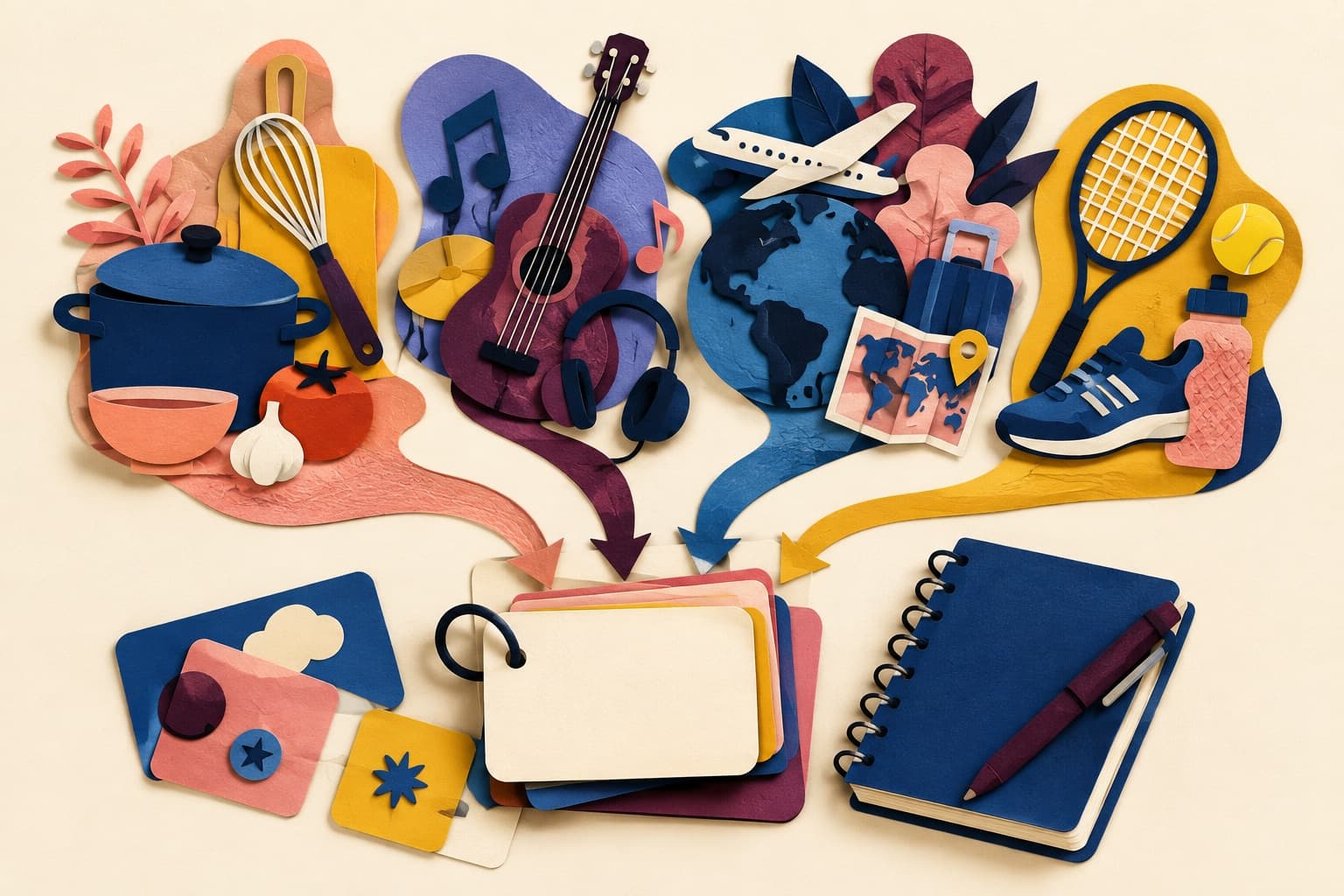
Start with interests, not categories
Many learners organize vocabulary by school-style categories: animals, colors, furniture, body parts, transportation. Those categories are neat, but they are not always motivating.
A better question is:
What French do I actually want to understand this month?
Then build vocabulary from that material.
| Interest | Real French source | Vocabulary you might collect |
|---|---|---|
| Cooking | Recipes, menus, food videos | ajouter, mélanger, cuire, une tranche, à feu doux |
| Travel | Transit pages, hotel messages, maps | un billet, un arrêt, réserver, en retard, le quai |
| News | Headlines, explainers, local articles | selon, une hausse, annoncer, cependant, en raison de |
| Immigration or public services | Government pages, forms, FAQs | une demande, remplir, un délai, exiger, les documents requis |
| School or work | Assignments, emails, summaries | rendre, un brouillon, la réunion, ci-joint, un échéancier |
| Culture | Film summaries, songs, reviews | un personnage, l'intrigue, émouvant, mettre en scène, à mon avis |
The point is not to avoid common vocabulary. The point is to meet common vocabulary inside material you are likely to revisit.
Learn words inside full sentences
Do not save only the French word and the English meaning. Save the sentence too.
For example, imagine you are reading a recipe:
Ajoutez les tomates et laissez cuire pendant dix minutes.
A weak vocabulary note would be:
| French | English |
|---|---|
| ajouter | to add |
| laisser | to leave / let |
| cuire | to cook |
A stronger note keeps the sentence context:
| Item | What to remember |
|---|---|
| ajoutez | Command form: “add.” Common in recipes and instructions. |
| laissez cuire | “Let cook.” A useful two-verb phrase. |
| pendant dix minutes | “For ten minutes.” Time duration pattern. |
| Full sentence | Ajoutez les tomates et laissez cuire pendant dix minutes. |
Now you are not learning three isolated words. You are learning a reusable instruction pattern.
Choose three to five words, not every unknown word
When you read real French, you will see more unknown words than you can review. Trying to save everything creates a vocabulary graveyard.
Pick only three to five items from each short text:
- One high-frequency word you expect to see again.
- One phrase or chunk that feels reusable.
- One topic word tied to your interest.
- One grammar-linked word such as a connector, pronoun, or preposition.
- One pronunciation challenge if the sentence is hard to say or hear.
For a travel page, that might be réserver, un billet aller-retour, la gare, jusqu'à, and prochain. For a news headline, it might be selon, une hausse, prévoir, malgré, and les habitants.
Small, repeated sets beat giant lists you never revisit.
Example: vocabulary from a real sentence
Take this sentence from a public-service style page:
Vous devez remplir le formulaire avant la date limite indiquée.
A direct translation is:
You must fill out the form before the indicated deadline.
For vocabulary practice, break it down this way:
| French | Meaning | Why it matters |
|---|---|---|
| vous devez | you must / you have to | Common obligation pattern. |
| remplir | to fill out | Useful for forms and applications. |
| le formulaire | the form | Common administrative noun. |
| avant | before | High-frequency time connector. |
| la date limite | the deadline | Useful school, work, and immigration vocabulary. |
| indiquée | indicated / shown | Often appears in official instructions. |
The strongest review item is not just remplir = to fill out. It is the whole pattern:
Vous devez remplir le formulaire avant... = You must fill out the form before...
That pattern can come back in school, work, travel, and government contexts.
Match vocabulary practice to your level
The same sentence can produce different vocabulary goals depending on your level.
| Level | What to focus on |
|---|---|
| A1 | Essential nouns and verbs: formulaire, remplir, avant |
| A2 | Common chunks: vous devez, date limite, avant la date limite |
| B1 | Sentence patterns: obligation + infinitive, connectors, formal instructions |
| B2 | Register, synonyms, and nuance: exiger, soumettre, dans les délais |
| C1+ | Style and domain language: administrative tone, legal nuance, implicit requirements |
This is one reason personalized vocabulary practice works better than a fixed list. A beginner and an intermediate learner can study the same text, but they should not extract the same lesson from it.
Build a simple review loop
Vocabulary does not become yours the first time you understand it. It becomes yours when you meet it again and can recognize it faster.
Use this review loop:
| When | What to do |
|---|---|
| Same day | Save the full sentence and listen to it once. |
| Next day | Cover the English and explain the sentence aloud. |
| Three days later | Write a new sentence using one phrase from the original. |
| One week later | Find the word again in a similar source. |
| Two weeks later | Keep only the words that still feel useful or difficult. |
Do not review every saved word forever. Let low-value words disappear. Keep the words and phrases that repeat across your interests.
Use audio so words become recognizable
A word you can read is not always a word you can hear. French has liaison, silent letters, reduced sounds, and rhythm that make familiar-looking words disappear in speech.
When you save a vocabulary item, listen to the whole sentence, not only the isolated word. For example:
- vous devez may sound like one smooth phrase
- les documents requis links rhythmically across words
- pendant dix minutes has a nasal vowel in pendant
- il faut remplir is more useful as a spoken chunk than as separate words
If a word matters enough to save, it is worth hearing in context.
Where Apprendr fits
Apprendr is built for this kind of vocabulary practice. You can bring in French from your life, choose your level, and turn one sentence into meaning, vocabulary, grammar notes, pronunciation audio, and review material.
Use the getting started flow if you want Apprendr to guide your first personalized lesson. Use the dashboard when you already have a sentence to study. Use the Chrome extension when you find French while browsing articles, public-service pages, recipes, social posts, or school material.
The goal is not to collect the biggest vocabulary list. The goal is to build a personal French vocabulary from words you actually meet, understand, hear, and review.
A weekly vocabulary routine
Try this three times per week:
| Time | Task |
|---|---|
| 2 minutes | Pick one short French source tied to your interests. |
| 5 minutes | Choose one sentence that is useful but not overwhelming. |
| 5 minutes | Extract three to five words, phrases, or chunks. |
| 3 minutes | Listen to the sentence and repeat it aloud. |
| 5 minutes | Review older words from the same interest area. |
After a month, you will have fewer random words and more useful sentence patterns. That is the difference between memorizing French vocabulary and building vocabulary you can actually use.
The main rule
Do not ask, “How many French words did I memorize today?”
Ask, “Which French words did I meet in real context, and which ones are worth seeing again?”
That question keeps your vocabulary practice personal, practical, and repeatable.