Short answer
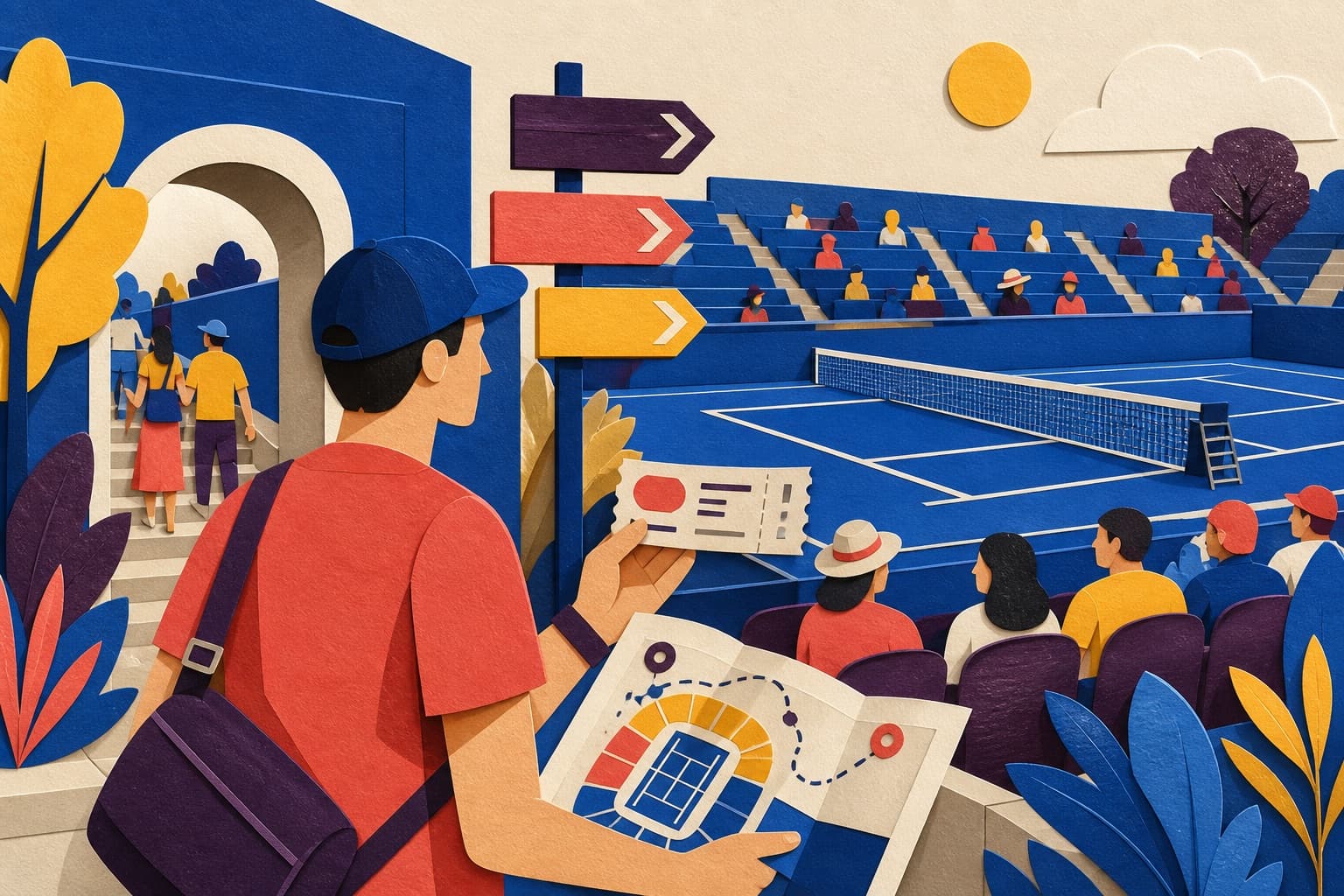
If you are going to the US Open in person, the best French practice is not only tennis vocabulary. It is the practical language around the match: finding the entrance, showing your ticket, going through security, locating your section, asking where the restrooms are, buying water, following the score, and leaving the venue.
A live sports event gives French learners useful phrases because the situation is concrete. You know what you need to do, so the language has a job.
Best workflow: choose one real task from the day, learn the French sentence for it, say it aloud, then review it after the match with one detail changed.
Best for: learners who want practical French for travel, events, venues, directions, tickets, food, and real-life situations.
Sources: US Open Fan Week, US Open Plan Your Visit, US Open prohibited items, US Open transportation and directions, and US Open ticket types.
Related guides: US Open Fan Week French tennis vocabulary, learn French from real-world text, French pronunciation audio, and Chrome extension.
A tennis match is a real-life French lesson
US Open Fan Week runs from August 23 to 29, 2026. The official visitor pages point fans toward practical planning topics: tickets, transportation, bag rules, security, access around the grounds, and the schedule of play.
That makes the event useful for French learners even if the match is happening in New York, not Paris or Montreal. You can turn the day into a practical French exercise by naming each task in French:
- arriving at the venue
- finding the entrance
- going through security
- showing a mobile ticket
- finding a court
- locating your seat
- asking for water
- finding the restrooms
- following the match
- leaving by subway, rail, or car
The goal is not to pretend everyone around you speaks French. The goal is to attach French to a real experience. A phrase you connect to a real entrance, seat, scoreboard, or bottle of water is much easier to remember than a phrase you saw once in a generic list.
Core sentence for the day
Study this sentence:
Je vais voir un match de tennis à l'US Open, donc je dois trouver l'entrée, présenter mon billet et chercher ma place.
Natural meaning:
I am going to see a tennis match at the US Open, so I need to find the entrance, show my ticket, and look for my seat.
This sentence gives you a full event-navigation pattern. You can use the same structure for a concert, a museum, a theatre, a school event, or a train trip.
Sentence breakdown
| French chunk | Natural meaning | Why it matters |
|---|---|---|
| Je vais voir | I am going to see | Useful for plans and events. |
| un match de tennis | a tennis match | Basic sports phrase. |
| à l'US Open | at the US Open | à marks an event or place. |
| donc | so / therefore | Connects the plan to what you need to do. |
| je dois | I need to / I must | Practical obligation. |
| trouver l'entrée | find the entrance | Event-navigation phrase. |
| présenter mon billet | show my ticket | Common at venues. |
| chercher ma place | look for my seat | Useful in stadiums, theatres, trains, and classrooms. |
The sentence is long enough to be useful but short enough to study in chunks. That is the sweet spot for practical French practice.
Arrival and entry vocabulary
Start with the words you need before you even see the court.
| French | English | Practice sentence |
|---|---|---|
| l'entrée | entrance | Je cherche l'entrée principale. |
| la sortie | exit | La sortie est à gauche. |
| la file | line / queue | La file avance lentement. |
| le contrôle de sécurité | security check | Je passe le contrôle de sécurité. |
| le billet | ticket | J'ai mon billet. |
| le billet mobile | mobile ticket | J'ai un billet mobile sur mon téléphone. |
| le sac | bag | Mon sac est petit. |
| les objets interdits | prohibited items | Je vérifie les objets interdits avant de partir. |
| les transports en commun | public transportation | Je prends les transports en commun. |
| le métro | subway / metro | Je rentre en métro après le match. |
| le train | train | Le train arrive près du stade. |
Useful phrases:
Où est l'entrée principale ?
Where is the main entrance?
Est-ce que cette file est pour les sacs ?
Is this line for bags?
J'ai un billet mobile.
I have a mobile ticket.
Je cherche le contrôle de sécurité.
I am looking for security.
Est-ce que ce sac est autorisé ?
Is this bag allowed?
Finding your court, section, and seat
Once you are inside, the next task is navigation. This is where French venue vocabulary becomes practical.
| French | English | Practice sentence |
|---|---|---|
| le court | court | Je cherche le court numéro cinq. |
| le stade | stadium | Le stade est plein. |
| la section | section | Ma section est près de l'entrée. |
| la rangée | row | Je suis dans la rangée F. |
| le siège | seat | Mon siège est ici. |
| la place | seat / spot | Je cherche ma place. |
| l'allée | aisle | L'allée est trop étroite. |
| l'escalier | stairs | Je prends l'escalier. |
| l'ascenseur | elevator | Où est l'ascenseur ? |
| le plan | map | Je regarde le plan du site. |
Useful phrases:
Je cherche ma section.
I am looking for my section.
Où est la rangée F ?
Where is row F?
Mon siège est dans cette section ?
Is my seat in this section?
Je crois que c'est ma place.
I think this is my seat.
Ce billet donne accès à quel court ?
Which court does this ticket give access to?
Food, water, and restrooms
Practical French gets useful fast when you need water, food, or a restroom.
| French | English | Practice sentence |
|---|---|---|
| les toilettes | restrooms | Où sont les toilettes ? |
| de l'eau | water | Je voudrais de l'eau. |
| une bouteille d'eau | a bottle of water | Je voudrais une bouteille d'eau. |
| remplir une bouteille | refill a bottle | Je peux remplir ma bouteille ? |
| un sandwich | a sandwich | Je prends un sandwich. |
| payer par carte | pay by card | Je vais payer par carte. |
| le comptoir | counter | Le comptoir est à droite. |
| la concession | concession stand | La concession est près de la sortie. |
| la caisse | checkout / register | La caisse est ouverte. |
| la pause | break | Je vais chercher de l'eau pendant la pause. |
Useful phrases:
Où sont les toilettes ?
Where are the restrooms?
Est-ce que je peux remplir ma bouteille ?
Can I refill my bottle?
Je voudrais une bouteille d'eau, s'il vous plaît.
I would like a bottle of water, please.
Est-ce que vous acceptez les cartes ?
Do you accept cards?
Je vais revenir avant le prochain set.
I am going to come back before the next set.
Watching and talking about the match
Now add the tennis itself.
| French | English | Practice sentence |
|---|---|---|
| le match commence | the match starts | Le match commence bientôt. |
| le premier set | first set | C'est le premier set. |
| le deuxième set | second set | Le deuxième set est serré. |
| le service | serve | Qui a le service ? |
| le retour | return | Son retour est puissant. |
| l'échange | rally | L'échange est long. |
| le point | point | Ce point est important. |
| l'arbitre | umpire | L'arbitre annonce le score. |
| le tableau d'affichage | scoreboard | Le score est sur le tableau d'affichage. |
| le public | crowd | Le public applaudit. |
Useful phrases:
À quelle heure commence le match ?
What time does the match start?
Qui sert ?
Who is serving?
C'est le premier set ?
Is it the first set?
Le score est affiché où ?
Where is the score shown?
Il y a beaucoup de vent aujourd'hui.
It is very windy today.
Grammar focus: Je cherche
One of the most useful phrases at any venue is:
Je cherche...
It means "I am looking for..."
Examples:
Je cherche l'entrée.
I am looking for the entrance.
Je cherche ma place.
I am looking for my seat.
Je cherche les toilettes.
I am looking for the restrooms.
Je cherche le court numéro cinq.
I am looking for court number five.
Je cherche la sortie.
I am looking for the exit.
This is better than memorizing only nouns. Once you know Je cherche, you can attach almost anything you need.
Grammar focus: Où est and Où sont
Use Où est... ? for singular nouns:
Où est l'entrée ?
Where is the entrance?
Où est la sortie ?
Where is the exit?
Où est le court ?
Where is the court?
Où est ma section ?
Where is my section?
Use Où sont... ? for plural nouns:
Où sont les toilettes ?
Where are the restrooms?
Où sont les concessions ?
Where are the concession stands?
Où sont les ascenseurs ?
Where are the elevators?
This is a high-value distinction for practical speaking. You do not need complex grammar to solve real problems. You need a phrase that gets you to the right place.
Grammar focus: Je dois + infinitive
The phrase je dois means "I need to" or "I must." After it, use the infinitive form of the next verb.
| French | English |
|---|---|
| Je dois trouver l'entrée. | I need to find the entrance. |
| Je dois présenter mon billet. | I need to show my ticket. |
| Je dois chercher ma place. | I need to look for my seat. |
| Je dois rentrer après le match. | I need to go home after the match. |
| Je dois vérifier l'horaire. | I need to check the schedule. |
You can reuse this outside the stadium:
Je dois prendre le train.
I need to take the train.
Je dois appeler un taxi.
I need to call a taxi.
Je dois acheter de l'eau.
I need to buy water.
That is why one match-day sentence can become travel French, city French, and everyday French.
A before-during-after practice routine
Before the match, say these five sentences aloud:
- Je vais voir un match de tennis.
- J'ai un billet mobile.
- Je cherche l'entrée.
- Je cherche ma place.
- Où sont les toilettes ?
During the match, save three words you actually used or noticed. They might be simple: la rangée, le score, le service, l'eau, la sortie.
After the match, write three sentences:
Le match était long.
The match was long.
Le stade était plein.
The stadium was full.
J'ai trouvé ma place facilement.
I found my seat easily.
Then add one tennis detail:
J'ai regardé un match en double mixte.
I watched a mixed doubles match.
Le public a applaudi après un long échange.
The crowd applauded after a long rally.
Je suis rentré en métro après le match.
I went home by subway after the match.
This turns the event into a memory anchor. You are not studying French because a textbook told you to. You are using French to describe something you actually did.
How Apprendr fits
Paste one sentence about your day into Apprendr:
Je vais voir un match de tennis à l'US Open, donc je dois trouver l'entrée, présenter mon billet et chercher ma place.
Apprendr can turn that real sentence into translation, grammar notes, vocabulary, audio, and review material. You can listen to the sentence, save phrases like je cherche, mon billet mobile, and ma place, then rewrite the same pattern for your next real event.
If you are reading venue pages, schedules, or French sports coverage online, the Chrome extension lets you highlight real French and keep moving without copying everything into another tab.
The point is simple: use the day you are already living. A tennis match can become French for directions, tickets, food, schedules, weather, and the match itself.